
For an industry which saw sales shrinking in 2013-14, this is hope indeed.

Close to half a dozen more three-row premium mid-size models are expected to hit the road over the next two years.

Optimistic buying in blue-chip stocks ahead of release of industrial production data for July and retail inflation for August drove stocks higher.

The board of Maruti Suzuki India (MSIL) on Tuesday approved a proposal to issue shares worth Rs 12,841 crore to parent company Suzuki Motor Corporation (SMC) for acquiring Suzuki Motor Gujarat (SMG). The Gujarat manufacturing plant - with an annual capacity of 750,000 units - is owned by SMG, a wholly-owned subsidiary of SMC. The shares issued to SMC will raise its ownership in MSIL from 56.48 per cent to 58.19 per cent--India's largest carmaker stated in a notice to BSE.

CURVV, currently in its production-ready avatar, will first be made available as an electric vehicle, to be followed by its internal combustion engine counterpart.

While commercial vehicles are expected to benefit from strong replacement demand, the two-wheeler and tractor segments are expected to gain from a recovery in the rural economy.
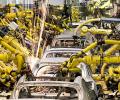
The sharp increase in commodity prices on account of the Russia-Ukraine war has put automakers in a fix. After the frequent price hikes in the current fiscal, manufacturers fear that any more price increases may further dent the already weak demand in certain segments. "We have taken several hikes and cannot immediately do it again. "We will have to closely watch the situation and act accordingly," said an official at an auto firm, declining to be identified. Even for companies like Tata Motors Passenger Vehicles, which has had a strong volume run and a robust order book, passing on the entire costs has been tough.

Domestic commercial-vehicle (CV) sales volume will witness significant growth over the next few years and the overall CV volume is likely to reach close to 1-million units by FY24, a report said on Wednesday. The report by credit ratings agency Fitch Ratings also expects growing demand and the resultant rise in operating leverage to boost the profitability of the domestic CV-focused original equipment manufacturers after FY22, despite elevated production costs. A recovery in medium and heavy CVs from multi-year lows, along with sustained growth in light CV categories, will help overall CV volume to reach close to 1-million units by FY24 - the level of the last cyclical peak recorded in FY19, it said.

'Bharat has been leading, but it cannot carry India as the bulk of the sales come from India in terms of volume and profitability.'

Maruti sold 191 units of SX4 sedan in January 2014.

The Mumbai headquartered company also overtook Japanese carmaker Honda to occupy the fourth spot in domestic passenger vehicle market.

Tata Motors is banking on revotron engine to tap the petrol passenger car segment with three modes of drive.

The offers mostly include free insurance, exchange bonus, and free accessories

Chinese automakers Great Wall Motors, FAW Haima Automobile, and Changan Automobile, after dithering about entering India for some years, have been encouraged by the robust sales performance of the late entrants Kia Motors and MG Motors even in a slowing market.

Car deliveries during the nine-day period saw sharp year-on-year (double-digit increase for most automobile companies.

Morgan Stanley Sales & Trading, US, believes the stock is better value for money than others and has a upside as high as 73 per cent. A slowdown in the economy has hit demand and led to a fall in overall consumption in an auto market which till recently was one of the fastest growing in the world.

The company's wholly-owned subsidiary PT Tata Motors Distribusi Indonesia has introduced Tata Aria, Tata Vista and Tata Safari Storme in the Indonesian market.

http://im.rediff.com/money/2023/jul/20uv.jpg

For players like Toyota Kirloskar and Ford, the contribution of UVs to overall sales is now well over 60%.

Ford is among several multinational automobile companies in India for whom exports now bring bigger volumes than local sales.

After a brief lull during the pandemic, there is a strong revival in luxury car sales, bolstered by more launches across price bands, replacement demand, ban on old diesel vehicles in the NCR, and 'revenge buying'.

Expanding investigation into allegedly wrongful claims of input tax credit by insurance companies, the tax authorities are probing a section of automobile dealers who have supposedly generated fake invoices without providing any service, which is a punishable offence under goods and services tax (GST) law. The authorities are learnt to have questioned the car dealers to explain the services they provided general insurance companies. The investigators suspect car dealers pitched for insurance schemes that give them commissions in excess of those insurance regulations permit.

Declining motorcycle sales remained a cause of worry.

In the two-wheeler segment, Bajaj Auto reported 31 per cent jump in total sales at 357,883 units in February against 273,513 units in the same month last year.

CEOs have complained that high interest rates have blocked their investment decisions. At the same time, customers are also deferring their purchases for new consumer durables, cars, and homes.

What's driving consumers to petrol cars? Ajay Modi finds out.

The margins of tyre manufacturers could come under pressure given the rise in rubber prices and the moderating demand for tyres. In the past three quarters, the revenue growth for listed tyre companies has moderated from low to mid-single-digit on account of factors such as lower demand in replacement segments, weak export markets and the decline in the average selling prices to car makers (OEMs). Demand trends could remain muted in the near term, given the weak passenger vehicle replacement demand, assuming a typical replacement cycle of 3-5 years, and demand moderation in the OEM segment.

Maruti recorded a 13.12% year-on-year surge in average revenue earned per car in 2023 compared to M&M's 7.56%, Hyundai's 6.76% and Tata Motors' 1.88%.

The entry level car, brainchild of Ratan Tata who envisaged giving a safer and affordable alternative to families riding on two-wheelers, received lacklustre response from the Indian consumer. Tata Motors to bid adieu to Nano from April 2020.

'This case is not a good example of intellectual property strategy for either sector.'

With car penetration of around 22 per 1,000 population, India continues to be a big opportunity to sell cars, especially in rural areas.

Despite a rise in input costs, leading car-makers refrain from hiking their price.

Maruti Suzuki India (MSI) will keep consolidating its existing product line-up, including hatchbacks, while bolstering presence in the fast growing SUV segment to power its way back to 50 per cent market share in the domestic passenger vehicle market, as per a senior company official. The country's largest carmaker, which has seen its market share drop to 43.38 per cent in FY22 from 47.7 per cent in FY21, aims to bring in multiple SUV products with focus on new technologies like hybrid powertrains in order to enhance fuel efficiency, making them comparable or better than diesel-powered models that are currently being sold in the market, especially by its Korean rivals. With no intention of making a comeback in the diesel segment, MSI is also focusing on increasing its play in the CNG segment to bring in additional volumes.

'India is the sixth-largest market for the Kia Corporation, and contributes 8 to 9 per cent to our global sales.' 'We are eyeing 10 per cent market share over the next few years depending on customer demand and new product innovations.'

VW cheating a 'well thought-out crime', diesel cars under lens

'Some of the launches may get deferred due to the semiconductor shortage, which is unlikely to get resolved before the second half of 2022.'

The EV industry is at an inflection point and batteries will play a critical role ahead -- batteries and related components typically constitute 35-45 per cent of an EV's costs.

The slowdown in growth is an industry-wide trend and companies are adjusting production to bring down the inventory levels at plants as well as dealerships.

Homegrown auto major Tata Motors on Tuesday said it will raise $1 billion (Rs 7,500 crore) in its passenger electric vehicle business from TPG Rise Climate at a valuation of up to $9.1 billion. Tata Motors Ltd (TML) and TPG Rise Climate, the dedicated climate investing strategy of private investment firm TPG, have entered into a binding agreement in this regard. Under the agreement, TPG Rise Climate along with its co-investor ADQ, will invest in a subsidiary of Tata Motors that will be newly incorporated, the company said in a statement.

Ahead of the international auto show that begins next Wednesday, the Indian auto industry continues to be buffeted with bad news. According to data released by leading automobile companies on Saturday, the industry's sales volumes in January fell about five per cent from those in the same month last year.
